Showing posts with label community. Show all posts

Thursday, 26 November 2020

Beach dynamics and recreational access changes

https://bit.ly/MarlboroughBeachReport
Link to report

The report responds to a request from Marlborough District Council (MDC) for information on the coastal environment, with a particular focus on supporting the development of a bylaw to address changes in recreational use patterns that have occurred since the Kaikōura earthquakeWe present a selection of information from our earthquake recovery research that has a focus on understanding the impacts and ongoing processes of change. 

Major impacts of the natural disaster are associated with vertical uplift of the coastal environment, although ongoing erosion and deposition processes are also important. Interactions with human activities are also important because they can exert strong influences on the reassembly of ecosystems which is a critical aspect of outcomes over the longer-term. 

Earthquake uplift caused widespread mortality of many coastal habitats and species (e.g., algal assemblages) that are adapted to a relatively specific set of conditions, often associated with characteristic locations in relation to the tidal range. In uplifted areas the intertidal zone has moved seaward leading to a physical widening of many beaches. This has provided greater opportunity for off-road vehicle access to the coast and has become particularly noticeable at headlands and other natural barriers that were previously impassable at high tide. Off-road vehicles pose threats to sensitive vegetation and wildlife unless appropriately managed. Achieving this is assisted by an understanding of the specific impacts of vehicle use, which in turn requires information on the location of sensitive areas. 

To ensure the best outcomes for earthquake recovery there is an urgent need to assess and respond to the new spatial patterns, and to make plans to avoid conflicts where possible.

Thursday, 15 October 2020

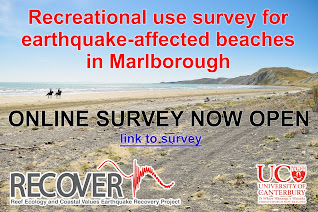
Marlborough beaches recreational survey

Marlborough beach survey

As part of our RECOVER earthquake recovery research the Marine Ecology Research Group has established an online survey to assist the Marlborough community in recording and understanding the level and types of recreational beach uses that are occurring at present on the earthquake-affected coast

We are hoping to capture a comprehensive view of recreational activities and interests. This information will be beneficial to the wider community to support decision-making on earthquake recovery needs and potential strategies for achieving the best outcomes looking ahead. The survey is open to all interested people who are 18+ years of age (for informed consent reasons) and have information they would like to share.

The survey questions are open-ended and allow for any activity, view or perspective to be recorded. Privacy will be maintained at all times and no identifying information is asked for or collected. UC will be preparing summaries of the results and these will be made freely accessible via an online link.

Please access the Marlborough survey on the following link www.surveymonkey.com/r/MarlboroughBeachSurvey


Wednesday, 31 July 2019

Tuesday, 29 January 2019

Recover newsletter issue 2 on Kaikōura coastal recovery


#RECOVER Issue 2 features paua population monitoring, hotspots for banded dotterels, and seaweed recovery experiments from the Kaikōura coast.

Available online here http://hdl.handle.net/10092/16796

Thursday, 25 October 2018

Inanga ora ki te awa o Waitara

It's been great working on this project with Waitara Alive and the Ōtaraua Hapū along with Waitara High School students to better understand the health of whitebait spawning sites along the Waitara River. 
The project is comparing present day spawning site health and abundance to historical evidence collected from local kaumatua. By contrasting past with present, the Inanga Ora project team hope to identify how spawning habitat is changing, and what can be done to better protect it.

The project was funded by the 'Curious Minds' He Hihiri I Te Mahara. Participatory Science Platform.
Check out a recent update from the Venture Taranaki here

Thursday, 21 June 2018

Recovery of near-shore environments from impacts of Kaikoura the earthquake

This article provides a summary of changes to the nearshore ecosystem resulting from uplift effects of the Kaikōura earthquake.

Our MBIE funded RECOVER project will be assessing initial recovery trajectories over a 130 km section of the earthquake-impacted coast.

Read more in NZ Coastal Society Special Publication 'Shaky Shores'
https://www.coastalsociety.org.nz/media/view/publications/shaky-shores-coastal-impacts-and-responses-to-the-2016-kaikoura-earthquakes/

Monday, 19 June 2017

Floodplain planning - a case study on regeneration oppportunities in a post-disaster setting

We're pleased to announce the findings of a three-part study on ecological 'regeneration' opportunities for the red-zoned lands in Avon / Ōtākaro river corridor. The study was supported by Avon-Ōtākaro Network in collaboration with Avon-Ōtākaro Forest Park and Greening the Red Zone.

This study provides an analysis of considerations for land-use planning (including sea level rise), with a focus on opportunities for ecological restoration and building resilience to climate change.

Thursday, 17 November 2016

Spawning habitat maps for Ōtautahi waterways

These maps show results from two years of spawning site surveys plus two years of straw bale experiments in the waterways of Ōtautahi Christchurch. Compare them with the Whaka Inaka maps where we took all of the known sites at the end of 2015 and tested if there might be others both in the gaps and further upstream/downstream. And yes there were.
These maps are available as free downloads. There's some other maps available too ..
check them out here www.resilientshorelines.nz/p/resources.html

Thursday, 15 September 2016

Workshop on coastal & marine citizen science


                   Link to the full report here


I teamed up with Helen Kettles (DOC) to run a workshop on Coastal & Marine Citizen Science in New Zealand as a side event for the NZ Marine Sciences Society (NZMSS) and Australian Marine Sciences Association (AMSA) 2016 conference in Wellington. This was a first meeting specific to coastal and marine citizen science in New Zealand. A group of 29 participants attended and there was a strong Australian contingent which added a welcome dimension to the conversation.

Friday, 19 August 2016

Using citizen science for coastal data collection

Citizen science has come of age in New Zealand and there are a wide range of opportunities for coastal scientists and practitioners to make use of, or contribute to it.

This recent article in Coastal News provides an overview of some recent highlights and progress in this fast moving field.

Read more >>


Thursday, 30 June 2016

Case study on community-led restoration projects and climate change

A case study of three coastal restoration projects looking at community-led approaches and climate change is in the new publication "Adapting to the consequences of climate change: Engaging with communities".

Link to the article here "Community-led approaches and climate change: Perspectives from coastal restoration projects"

The aim of this new NZCS publication is to support work with communities as they adapt to the consequences of climate change. It has been written to assist coastal professionals, decision-makers and communities in preparing for sea-level rise and the associated effects of climate change.

Thursday, 1 October 2015

Whaka Inaka project gaining media attention


Whaka Inaka: Causing Whitebait is a joint collaboration between EOS Ecology, Ngāi Tahu, and the University of Canterbury (UC). We recently receiving funding from the Department of Conservation Community Fund, and together with support from Brian Mason Trust, and businesses such as Ravensdown the project is getting underway!

Contact Form

Name

Email *

Message *

Pageviews
