Showing posts with label publications. Show all posts

Monday, 8 February 2021

Biogeography of Whitebait spawning grounds at non-tidal rivermouths

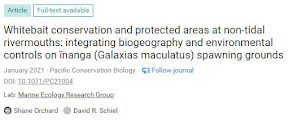
We recently published a study of īnanga (Galaxias maculatus) spawning grounds at non-tidal rivermouths in Pacific Conservation Biology

http://bit.ly/non-tidal-spawning_PCB
Article freely available here

Non-tidal rivermouths are common on the east coast of the South island and south-east of the North Island where they are commonly associated with high energy mixed sand-gravel beaches that form perched lagoons or hāpua at the rivermouth. 

At the outset of the study the spatial pattern of spawning in these environments grounds was unknown. Some of the interesting findings were that the location of spawning was close to the rivermouth despite the lack of salt water intrusion or tidal influence, both of which are associated with spawning grounds in tidal situations. 

A downstream fish migration evidently still occurs prior to spawning events and fish movements were surprisingly rapid in response to spawning cues in many instances. Spawning events are triggered by water level changes as occurs in tidal rivermouths, but appear to be more haphazard due to their origins being rain events rather than regular tidal cycles.Geographical aspects of the spawning locations were remarkably consistent across all seven study sites in key aspects such as the position in the catchment, relationship with water changes and presence of riparian vegetation. 

This provides a solid basis for identifying and managing spawning habitat in other non-tidal rivers. Effects we recorded included spawning on flood events that resulted in spawning grounds being located some distance from the active channel. As with tidal situations this places the eggs at risk from human activities in those same zones, but potentially presents a more difficult management proposition due to these events being less predictable. Their irregular nature suggests they are less likely to be accommodated in riparian zone planning and management. Importantly, the spawning grounds are located close to the peak water levels experienced on these events, which coincides with areas that are only briefly inundated. 

Recognising and protecting these emphemeral flood-zone areas is the key to effective conservation.

Read the full article here



Monday, 13 July 2020

Coastal tectonics and habitat squeeze

We're pleased to announce publication of a new paper in the international journal Natural Hazards.
This is the first chapter in the 'Resilient Shorelines' Ph.D. 

dx.doi.org/10.1007/s11069-020-04147-w

The Canterbury earthquakes provided a rare opportunity to observe the actual effects of a sea-level rise event. This study explores the impacts of hydrological changes resulting from tectonic ground movement in low-lying coastal environments, and draws analogies with future climate change.


The paper describes landscape-scale changes and assess interactions with human land-use patterns and disaster recovery responses that include a large scale managed retreat. The results illustrate mechanisms by which 'coastal squeeze' effects may occur with sea-level rise - and also ways to avoid them through innovative planning and design.  

Principles identifiable from the actual impacts in this case provide useful insights for other situations of sea-level rise.

We highlight the need for an improved focus on whole-system resilience in responding to sea-level changes, and the importance of disaster recovery processes for adaptation to climate change.

Thursday, 20 June 2019

Kaikōura earthquake recovery - loss of connectivity and the necessity of a cross‐ecosystem perspective

Article just published in Aquatic Conservation: Marine and Freshwater Resources from our Kaikōura earthquake recovery work.

The Kaikōura earthquake in southern New Zealand: Loss of connectivity of marine communities and the necessity of a cross‐ecosystem perspective.
https://doi.org/10.1002/aqc.3122

Monday, 11 June 2018

Earthquakes cause the relocation of spawning habitat on a catchment scale

The story of how whitebait spawning sites shifted to new areas after the Canterbury earthquakes - and became exposed to new vulnerabilities.
This spatial ecology study reveals how and where we can take action to protect them.


Read more here

Tuesday, 5 June 2018

Using artificial habitats as a natural habitat detection tool


We have a new paper published in the journal Ecological Indicators that describes the science behind using artificial habitats (such as straw bales) to as a detection tool.

We used this approach to help identify īnanga spawning habitat in degraded waterways where egg mortality can make it difficult to find the eggs directly.

Read more here

Monday, 6 November 2017

New methods paper - Census survey approach for īnanga spawning habitat

Waterways and MERG have recently published details of a survey methodology for locating and mapping īnanga spawning sites near coastal rivermouths. 

Read more here.


Thursday, 15 September 2016

Workshop on coastal & marine citizen science


                   Link to the full report here


I teamed up with Helen Kettles (DOC) to run a workshop on Coastal & Marine Citizen Science in New Zealand as a side event for the NZ Marine Sciences Society (NZMSS) and Australian Marine Sciences Association (AMSA) 2016 conference in Wellington. This was a first meeting specific to coastal and marine citizen science in New Zealand. A group of 29 participants attended and there was a strong Australian contingent which added a welcome dimension to the conversation.

Thursday, 30 June 2016

Case study on community-led restoration projects and climate change

A case study of three coastal restoration projects looking at community-led approaches and climate change is in the new publication "Adapting to the consequences of climate change: Engaging with communities".

Link to the article here "Community-led approaches and climate change: Perspectives from coastal restoration projects"

The aim of this new NZCS publication is to support work with communities as they adapt to the consequences of climate change. It has been written to assist coastal professionals, decision-makers and communities in preparing for sea-level rise and the associated effects of climate change.

Contact Form

Name

Email *

Message *

Pageviews