 #RECOVER newsletter Issue 1 summarises massive changes on the #Kaikōura coast. Available online here https://ir.canterbury.ac.nz/handle/10092/16795
Friday, 26 October 2018
Recover newsletter issue 1 on Kaikōura coastal recovery
#RECOVER newsletter Issue 1 summarises massive changes on the #Kaikōura coast. Available online here https://ir.canterbury.ac.nz/handle/10092/16795

Thursday, 25 October 2018
Inanga ora ki te awa o Waitara

It's been great working on this project with Waitara Alive and the Ōtaraua Hapū along with Waitara High School students to better understand the health of whitebait spawning sites along the Waitara River.
The project is comparing present day spawning site health and
abundance to historical evidence collected from local kaumatua.
By contrasting past with present, the Inanga Ora project team
hope to identify how spawning habitat is changing, and what can
be done to better protect it.
The project was funded by the 'Curious Minds' He Hihiri I Te Mahara. Participatory Science Platform.
Check out a recent update from the Venture Taranaki here
Check out a recent update from the Venture Taranaki here
Thursday, 21 June 2018
Recovery of near-shore environments from impacts of Kaikoura the earthquake
 This article provides a summary of changes to the nearshore ecosystem resulting from uplift effects of the Kaikōura earthquake.
Our MBIE funded RECOVER project will be assessing initial recovery trajectories over a 130 km section of the earthquake-impacted coast.
Read more in NZ Coastal Society Special Publication 'Shaky Shores'
https://www.coastalsociety.org.nz/media/view/publications/shaky-shores-coastal-impacts-and-responses-to-the-2016-kaikoura-earthquakes/
Monday, 11 June 2018
Earthquakes cause the relocation of spawning habitat on a catchment scale
 The story of how whitebait spawning sites shifted to new areas after the Canterbury earthquakes - and became exposed to new vulnerabilities.
This spatial ecology study reveals how and where we can take action to protect them.
Read more here
Tuesday, 5 June 2018
Using artificial habitats as a natural habitat detection tool
 We have a new paper published in the journal Ecological Indicators that describes the science behind using artificial habitats (such as straw bales) to as a detection tool.
We used this approach to help identify īnanga spawning habitat in degraded waterways where egg mortality can make it difficult to find the eggs directly.
Read more here
Monday, 6 November 2017
New methods paper - Census survey approach for īnanga spawning habitat
 Waterways and MERG have recently published details of a survey
methodology for locating and mapping īnanga spawning sites near coastal
rivermouths.
Waterways and MERG have recently published details of a survey
methodology for locating and mapping īnanga spawning sites near coastal
rivermouths.
Read more here.

Wednesday, 1 November 2017
Evaluation of Christchurch City Council's riparian management trial
 Christchurch City Council (CCC) recently changed its riparian vegetation clearance practices for a trial period in the summer of 2016/17. While the trial has wider objectives around improved environmental outcomes, īnanga spawning habitat is directly affected by bank cutting and other forms of vegetation clearance. A survey of īnanga (Galaxias maculatus) spawning habitat was completed in April 2017 to evaluate effects of the trial.
Benefits of the trial included increasing the availability of high quality spawning habitat and the discovery of new spawning sites. The Avon/Ōtākaro supported a relatively high area of occupation (AOO) of spawning sites for a single month in comparison to other years. In the Heathcote/Ōpāwaho spawning was found at new sites including upstream of Opawa Road. However, egg production was relatively low in the Heathcote/Ōpāwaho versus the same month in previous years. This suggests a shift in the month of peak spawning activity or a possible adult population decline and requires consecutive month surveys to confirm the actual trend.
The full report is available on the CCC website here:
Response of īnanga spawning habitat to riparian vegetation management
Response of īnanga spawning habitat to riparian vegetation management
Monday, 19 June 2017
Floodplain planning - a case study on regeneration oppportunities in a post-disaster setting
We're pleased to announce the findings of a three-part study on ecological 'regeneration' opportunities for the red-zoned lands in Avon / Ōtākaro river corridor. The study was supported by Avon-Ōtākaro Network in collaboration with Avon-Ōtākaro Forest Park and Greening the Red Zone.
 This study provides an analysis of considerations for land-use planning (including sea level rise), with a focus on opportunities for ecological restoration and building resilience to climate change.

Monday, 12 June 2017
NZ's largest known area of inanga spawning found in Christchurch waterways!
An unexpected result of our earthquake studies was the discovery that īnanga spawning habitat had expanded, and was more extensive than ever previously recorded in Christchurch's waterways.
 Further surveys in 2016 found that even larger areas were being used. The total area of spawning was around 2x
the next largest area recorded anywhere in New Zealand !
Read more >>
 Further surveys in 2016 found that even larger areas were being used. The total area of spawning was around 2x
the next largest area recorded anywhere in New Zealand !
Read more >>
Monday, 5 June 2017
New spawning sites found in Aromahana Lagoon in Greymouth
 Dr. Mike Hickford and I recently visited an community restoration project on Cobden Island in the Grey River and nearby Aromahana Lagoon. Our main goal was to scope out a survey strategy for monitoring īnanga spawning in this area. Time was short but we did manage to find two new spawning sites.
 This is an innovative floodplain restoration project on an impressive scale. Thanks to Henk Stengs at DOC for showing us around!
Read more >>
Tuesday, 3 January 2017
New Zealand Coastal Society award
Thanks to the New Zealand Coastal Society for the Best Overall Presentation prize at the 2016 New Zealand Coastal Society conference He Waka Eke Noa: Linking Science, Engineering, Management and Community. I was completely taken by surprise given the many excellent speakers!
 The conference is held each year and attracts diverse attendance from scientists, engineers, and planners, with presentation covering a wide range of contemporary management topics.
Read more >>
 The conference is held each year and attracts diverse attendance from scientists, engineers, and planners, with presentation covering a wide range of contemporary management topics.
Read more >>
Thursday, 17 November 2016
Spawning habitat maps for Ōtautahi waterways
 These maps show results from two years of spawning site surveys plus two years of straw bale experiments in the waterways of Ōtautahi Christchurch. Compare them with the Whaka Inaka maps where we took all of the known sites at the end of 2015 and tested if there might be others both in the gaps and further upstream/downstream. And yes there were.
These maps are available as free downloads. There's some other maps available too ..
check them out here www.resilientshorelines.nz/p/resources.html
check them out here www.resilientshorelines.nz/p/resources.html
Friday, 4 November 2016
Resilience research on whitebait featured in UC Chronicle
 The September 2016 issue of the Chronicle He Kupu Whakamahara ran a story on our research into the resilience of whitebait spawning sites in Ōtautahi Christchurch following the earthquakes.
Follow the link here to the article online
Some recent publications relating to this work:
- Earthquake effects on spawning sites - download the original report here
- Identifying īnanga spawning sites in plans - short report available here
- Census survey approach to quantifying īnanga spawning habitat New Zealand Journal of Marine and Freshwater Research, 52(2), 284-294.
- Earthquake-induced habitat migration Aquatic Conservation: Marine and Freshwater Ecosystems, 2018; 1-11.
Thursday, 15 September 2016
Workshop on coastal & marine citizen science

I teamed up with Helen Kettles (DOC) to run a workshop on Coastal & Marine Citizen Science in New Zealand as a side event for the NZ Marine Sciences Society (NZMSS) and Australian Marine Sciences Association (AMSA) 2016 conference in Wellington. This was a first meeting specific to coastal and marine citizen science in New Zealand. A group of 29 participants attended and there was a strong Australian contingent which added a welcome dimension to the conversation.
Friday, 19 August 2016
Using citizen science for coastal data collection
 Citizen science has come of age in New Zealand and there are a wide range of opportunities for coastal scientists and practitioners to make use of, or contribute to it.
This recent article in Coastal News provides an overview of some recent highlights and progress in this fast moving field.
Read more >>
Thursday, 30 June 2016
Case study on community-led restoration projects and climate change

Link to the article here "Community-led approaches and climate change: Perspectives from coastal restoration projects"
The aim of this new NZCS publication is to support work with communities as they adapt to the consequences of climate change. It has been written to assist coastal professionals, decision-makers and communities in preparing for sea-level rise and the associated effects of climate change.
Monday, 27 June 2016
Ngāi Tahu Research Centre seminar: earthquake recovery in Ōtautahi Christchurch watwerways

Results from our research into the effects of the Canterbury earthquakes on īnanga spawning sites in the Avon Heathcote Estuary / Ihutai catchment in Ōtautahi Christchurch. It's a story of the resilience and recovery of an iconic New Zealand species following a major disturbance. Thanks to the Ngāi Tahu Research Centre and UC Audio Visual unit the recent seminar was videoed. View the clip on U-tube here.
Thursday, 17 March 2016
New report on earthquake effects
 The Waterways Centre for Freshwater Research
and the Marine Ecology Research Group are pleased to provide a new report on
the distribution of īnanga spawning sites in Ōtautahi Christchurch. Thanks to the Engineering New Zealand / Water NZ Rivers Group for supporting this work.
The Waterways Centre for Freshwater Research
and the Marine Ecology Research Group are pleased to provide a new report on
the distribution of īnanga spawning sites in Ōtautahi Christchurch. Thanks to the Engineering New Zealand / Water NZ Rivers Group for supporting this work.Highlights include comprehensive information on changes in relation to the Canterbury earthquakes, and a summary of the key implications for waterways management.
Wednesday, 16 March 2016
Comparative study of coastal hydrosystems
Over the 2016 summer we are surveying eight coastal hydrosystems for a comparative study. Four study sites are in Canterbury and four on the West Coast. The study sites have been chosen to represent a range of different rivermouth and estuarine environments and a wide range of data are being collected to characterise each site in ecosystem terms. Look out for more news from these surveys in the coming months.
Tuesday, 1 December 2015
2015 hottest year on record?
This recent information from NOAA is worth a look. It that shows very warm global conditions have prevailed since January.
via GIPHY
Read more about the trend versus historical averages on the Think Progress site here.
And some recent comment on the 10 things you need to know about climate change with implications for New Zealand.
There's a lot going on in the lead-up to the COP21 climate change summit in Paris ... watch this space!
via GIPHY
Read more about the trend versus historical averages on the Think Progress site here.
And some recent comment on the 10 things you need to know about climate change with implications for New Zealand.
There's a lot going on in the lead-up to the COP21 climate change summit in Paris ... watch this space!
Wednesday, 25 November 2015
Te Karere Interview: Ngāi Tahu team up with scientists for whitebait restoration project
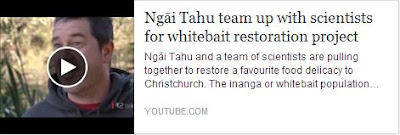
Watch the news video here
Thursday, 1 October 2015
Whaka Inaka project gaining media attention

Whaka Inaka: Causing Whitebait is a joint collaboration between EOS Ecology, Ngāi Tahu, and the University of Canterbury (UC). We recently receiving funding from the Department of Conservation Community Fund, and together with support from Brian Mason Trust, and businesses such as Ravensdown the project is getting underway!
Friday, 11 September 2015
Coastal Restoration Trust award
 A big thank you to the Dunes Trust for adding their support to our to our dune management case study.
Visit www.dunestrust.org.nz for more information on conservation and restoration New Zealand’s dune ecosystems.
Tuesday, 4 August 2015
Collaboration with NIWA to develop salinity models
 The Resilient Shorelines team would like to thank the Brian Mason Scientific & Technical Trust and also NIWA for bringing their support to this exciting research.
An interesting though unexpected finding of this work was the discovery of a leak in the Woolston Tidal Barrage. The model calibration was excellent in the lower estuary and in the Avon / Ōtākaro. However there was a strong anomaly between the modelled versus observed salinity datasets for the Heathcote / Ōpāwaho that have been influenced by the tidal barrage leakage. Read more about it here in the Brian Mason Trust report on 'Development of a fine-scale salinity model for the Avon Heathcote Estuary Ihutai'.
Read more here
Friday, 10 July 2015
Earthquakes cause a shift in the location of īnanga spawning sites

And the answer is - yes, there has been a major shift in the location of spawning compared to all previous records!
Read more here
Tuesday, 23 June 2015

Subscribe to:
Posts (Atom)